
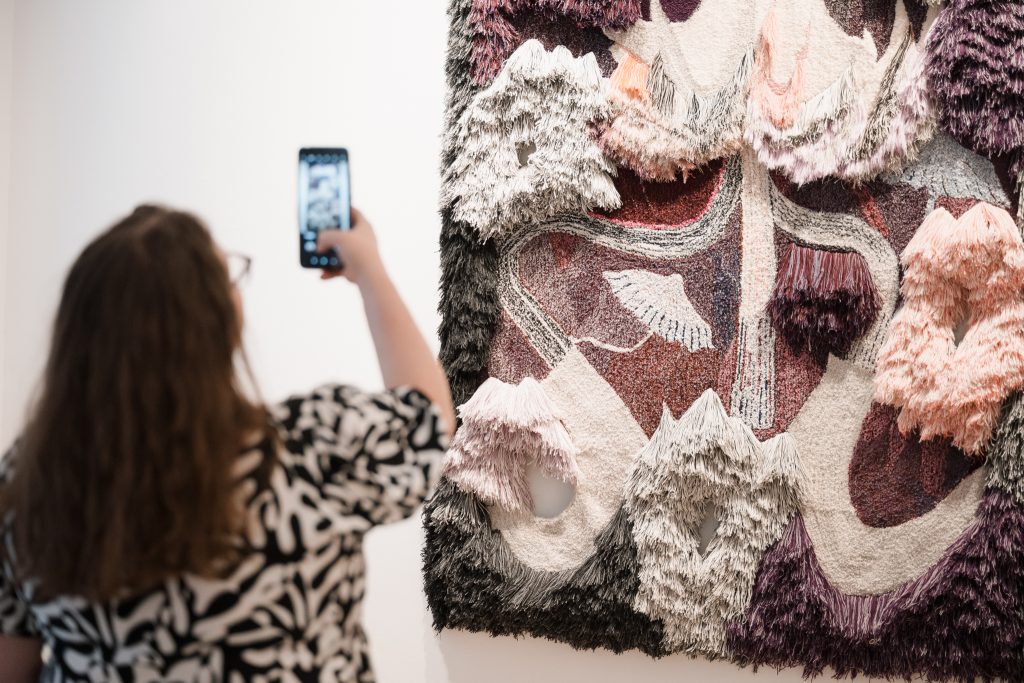
Autumn has arrived. The first autumn rains have just fallen and soaked the thirsty soil. The weather lagged slightly behind the calendar as September began. This is the time when we enter that perfect season for longer excursions or hikes, we can wander through the woods without risking heatstroke. With the first spells of cooler, wetter weather, forest mushrooms begin to push their fruiting bodies up through the soil, briefly revealing themselves to those who happen to pass by. Laura Põld’s new exhibition opened on 3 September, when summer still ruled the city and the last heatwave had passed only a few days earlier. Despite this, stepping into Põld’s new exhibition was like entering a cool and rainy forest, where everything is a bit moist: half-familiar and inviting, half-alien and unsettling. As this opening may already suggest, I found myself at another exhibition preview. Beautiful Pulsating Web, a new show by the Estonian artist, opened at Kahan Art Space Pest. I am continually surprised by how well certain artistic concepts can work within this small, partitioned exhibition space. Laura Põld’s works seem to have taken possession of it almost completely, even though the exhibition was not conceived specifically for this venue and came here from Vienna.
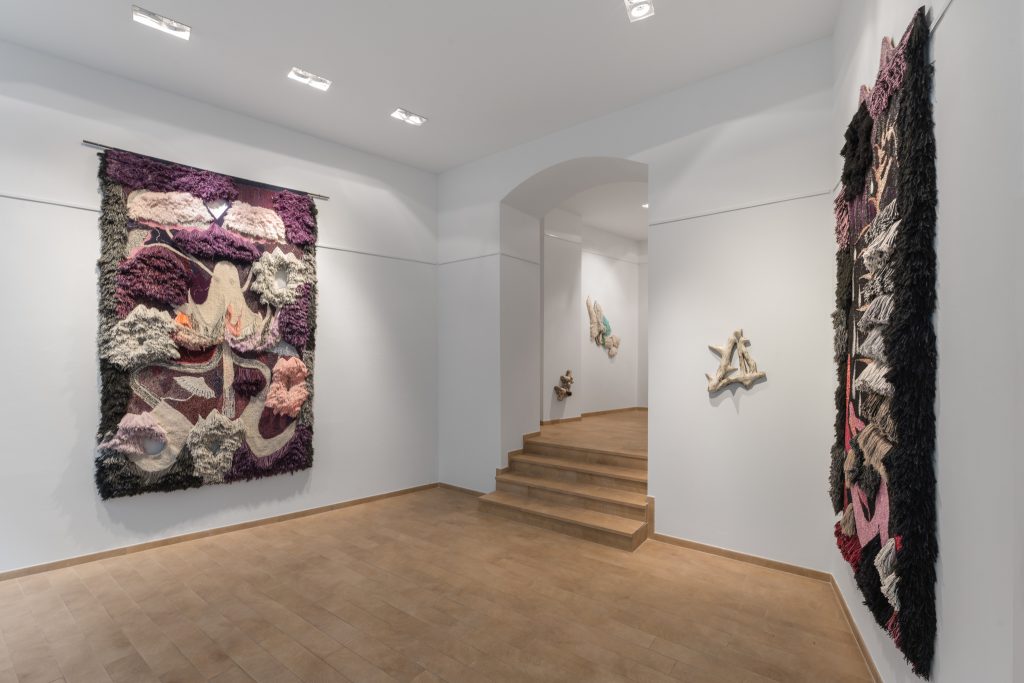
The Estonian artist works primarily with ceramics and textiles, combining the two to create a kind of organic art. Her artworks, appearances notwithstanding, are not reproductions of nature. Rather, they attempt to grasp the essence of living matter, revealing its deeper structures and presenting them to the viewer as parts of an interconnected whole. Põld’s sculptures, three-dimensional works and hand-woven tapestries are striking, distinctive and thought-provoking even when considered individually, yet they also contain a deeper philosophical dimension.
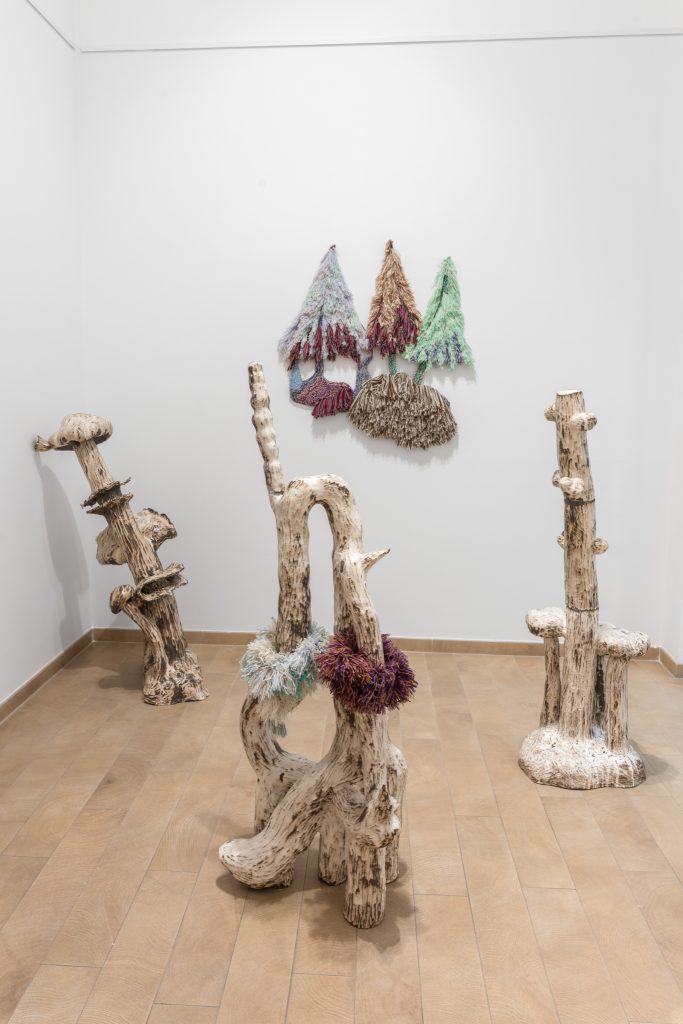
In her art, Põld translates Michael Marder’s theory of “plant-thinking” into spatial forms. The idea that plants might be capable of thought may initially sound radical, yet perhaps less so today when we remember that, not so very long ago, animals too were denied the capacity for thought, judgement or deliberation. Today there is little doubt that certain animals possess highly developed cognitive abilities and complex emotional lives. Why, then, should we not extend the question to the plant world?Marder, however, does not suggest that “plant-thinking” is merely a simplified version of human thought. Instead, he understands it in terms of continuous connection and mutual dependence, as well as an ability to make the most of given conditions—nutrients, water and sunlight.
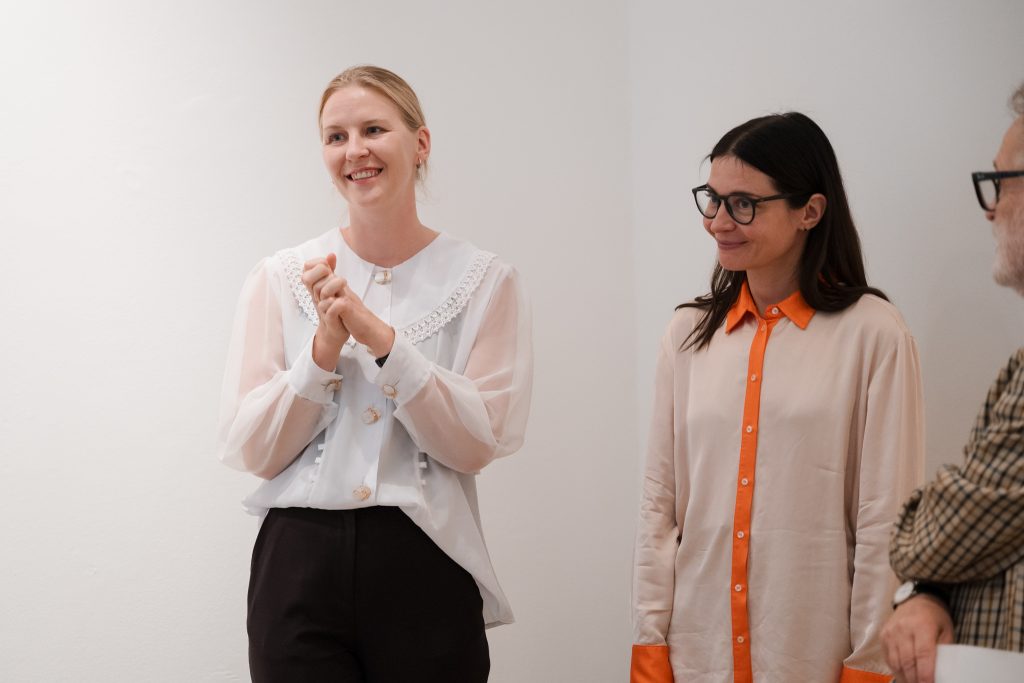
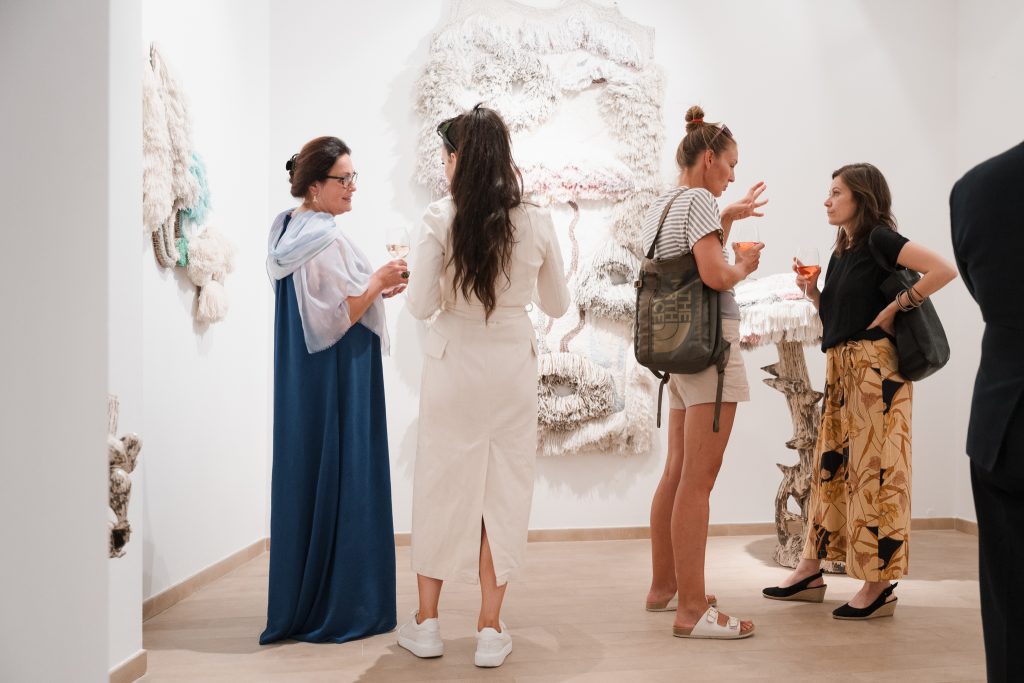
Lilian Hiob-Küttis, curator (l.), Laura Põld (c) and Sándor Feldmájer (r.)
Plant intelligence also differs from its human counterpart in its lack of individualism, of a single fixed point from which the world is perceived. Plants grow, spread, connect and, when necessary, grow again. They have no clearly identifiable centre. Their existence is characterised by a tendency towards the optimum and, in this sense, they possess their own form of rationality. Looking at the natural world from this perspective can transform our relationship with the trees in a city park, the plants we nurture on our balconies, or even the mushrooms we encounter while hiking. Marder’s ideas resonate throughout Laura Põld’s woven works, ceramic forms and mushrooms of various shapes and sizes.Leaving aside the fact that fungi are not, taxonomically speaking, plants, they nevertheless provide a perfect visual representation of the hidden structures, networks and connections that remain invisible to the human eye because they take shape beneath the soil and at the cellular level.
Never have I been to Estonia, nor have I ever seen its forests, meadows or boglands with my own eyes, yet Põld has somehow managed to bring a convincing fragment of that northern landscape to Nagy Diófa Street in Budapest. On entering the gallery, the first things to command attention are the large, densely woven rugs and wall hangings. Made from hand-knotted and individually dyed strands of wool, they are almost overgrown in appearance, expanding outwards into three dimensions. They are works of astonishing craftsmanship. Beyond artistic creativity, their production requires exceptional technical skill, extensive experience and remarkable perseverance. At a time when speed, instant results and an almost fetishised notion of efficiency have become cultural watchwords, a textile piece that takes half a year to complete is arguably every bit as radical as attributing thought to plants.
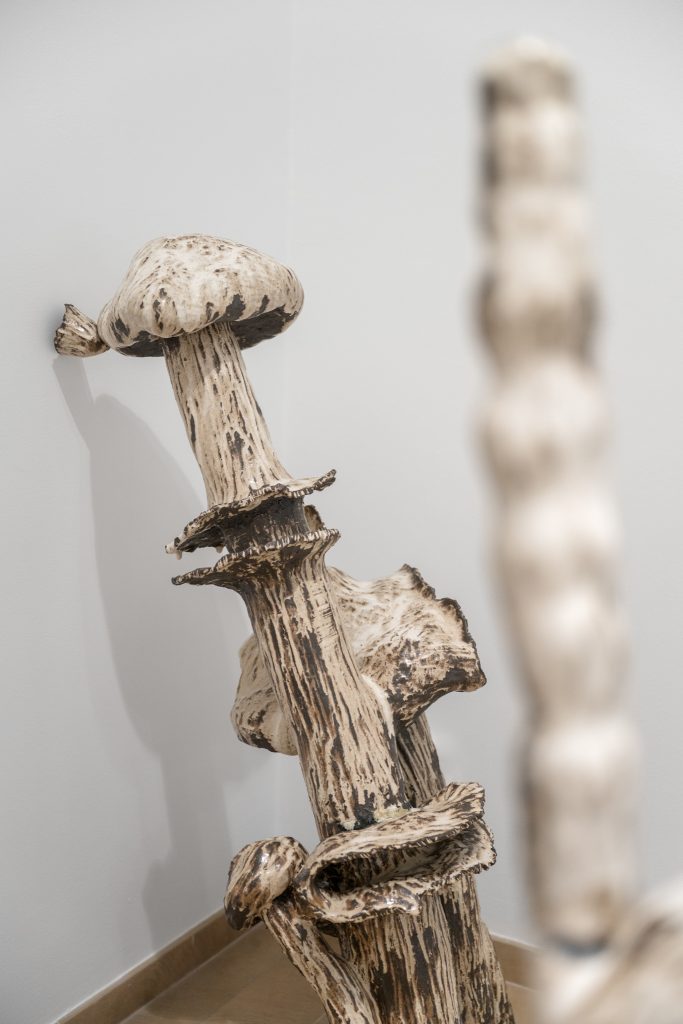
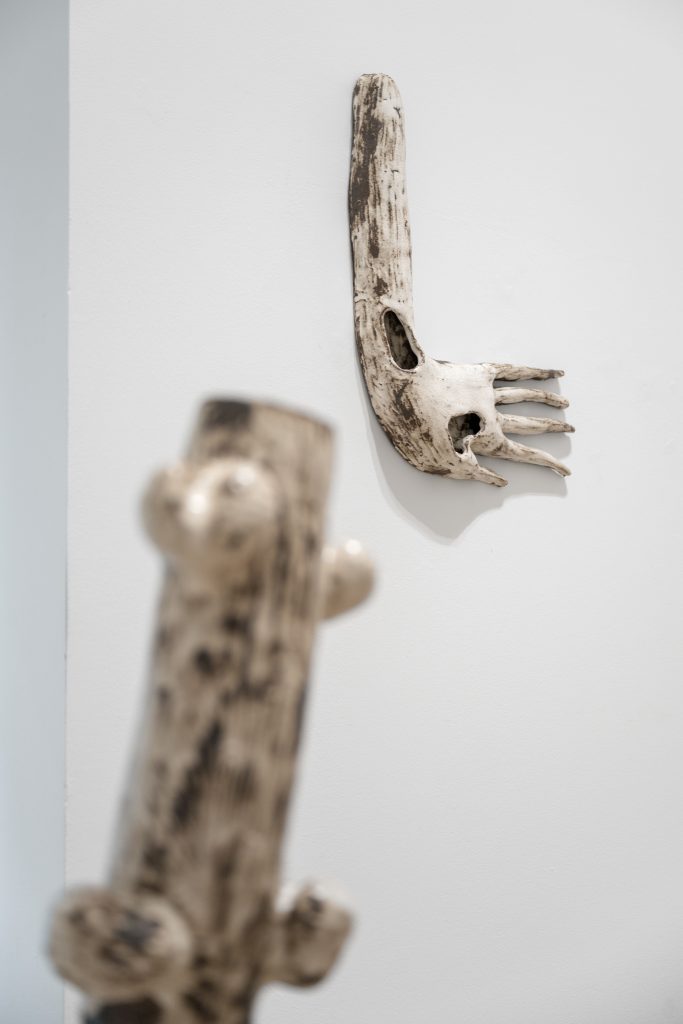
Look more closely at the tapestries, and mushrooms begin to emerge. Fruiting bodies appear here and there among the densely woven, elongated fibres, much as they do in nature, while the fungal filaments that form their vast hidden networks remain beneath the ground. And as one moves through the gallery, mushrooms begin to appear everywhere, in an array of sizes and forms. Some are made entirely of ceramic. At first glance, these do not necessarily resemble mushrooms at all: they look more like partially melted snowmen built from dirty snow, or creatures formed from some sticky, viscous substance. Despite their pale colouring, they evoke darker sensations and associations. Elsewhere, however, there is a charming, almost fairy-tale-like mushroom with a ceramic stem and a woven cap, standing as tall as a five- or six-year-old child. Various species of fungi fashioned from textiles also appear on the walls. At moments like these, one may regret never having spent enough time with a mushroom field guide.
Alongside fungi, rhizomes—the underground stems of plants—also belong to the concealed vegetal world that clearly fascinates the artist. Unlike fungal filaments, however, a rhizome is not primarily a branching network reaching out in search of connections. It serves the plant’s survival, storing nutrients and water, while also enabling new plants to emerge through vegetative reproduction. Laura Põld’s world is a world without human beings: a place from which people have disappeared, or perhaps one in which they never existed at all, and where plants and fungi reign instead. There are not even any animals. In such a world, thought, connection and existence itself take on different meanings. I would recommend the exhibition to anyone—whether simply for its atmosphere or for the deeper questions it quietly raises.
Author: Péter Szász
Photographs: Réka Hegyháti